If Also Running a Physical Cigar Store, at Which Stage Is Profit Highest and Risk Greatest
Let me put the conclusion on the table first: The riskiest period is the overlapping 8–18 months from the investment period through the first half of the payback period; the highest book profit and the easiest days are usually the two years after inventory starts to "behave" in the stable period.
Many people imagine physical cigar sales as "high margin, small and beautiful." Margins are indeed high, but money can easily die on the shelves first. Below I break it down by investment period, payback period, and stable period — not a textbook three-stage formula, but a look at which month you will start to gasp for air when money flows out of your pocket and then flows back.
I. Where Is a Cigar Business Actually "Heavy": Not Renovation, But Humidity and Time
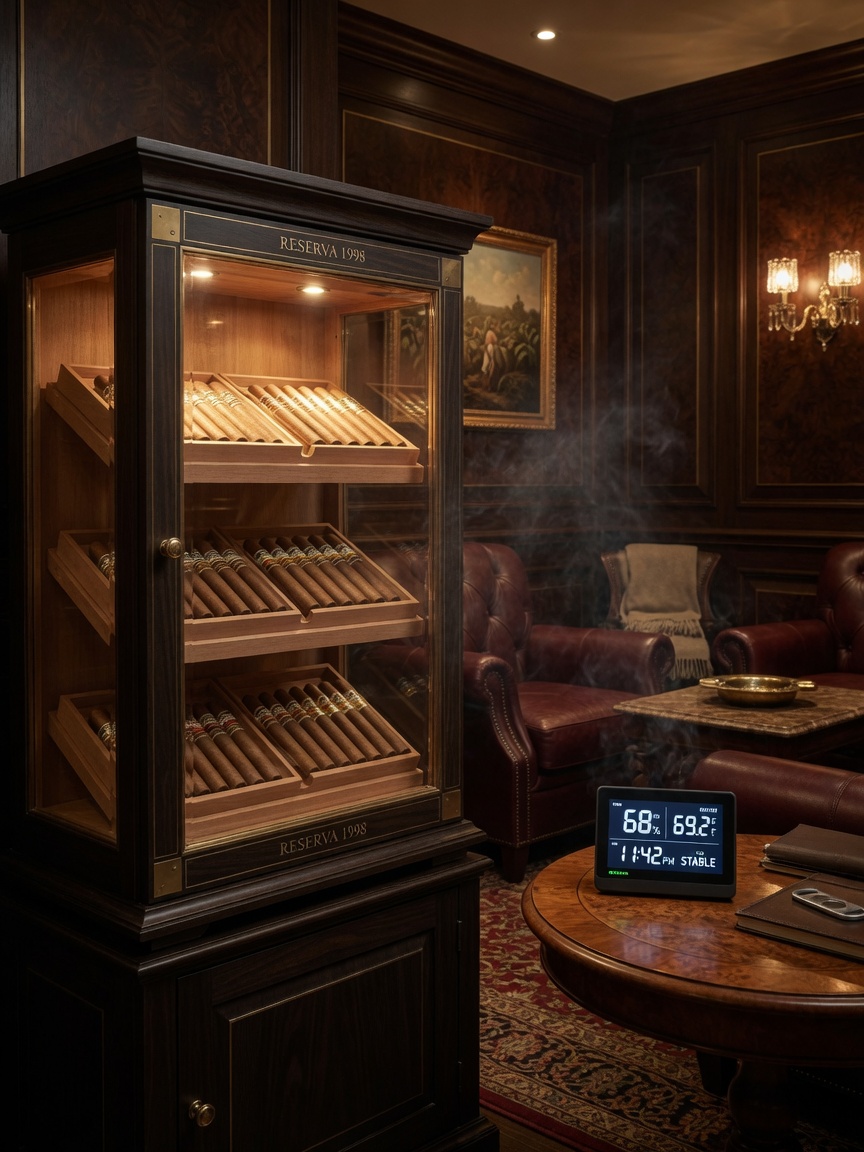
Let me first align on the business model. What I mean by "also running a physical cigar sales" is: your main business might be smoking accessories, heat-not-burn, smoking cessation-related categories, or comprehensive tobacco retail, with an additional real cigar display and retail section — constant temperature and humidity cabinets, box/single stick sales, occasionally some tasting sessions, not online drop-shipping.
The heavy asset nature of this business is concentrated in three things:
1. Inventory locks up cash in one go
Premium cigar purchase prices commonly range from tens to hundreds per stick. In retail mix operations, gross margin typically falls in the 45%–55% range: buying at 4 and selling at 10 looks great, but only if that cigar sells within 90 days. For stores with poor assortment, turnover drags to 120–150 days is normal; after that, the goods are still there, but the money is no longer in your hands.
2. The humidity system is a sunk cost
Commercial display cabinets, backup humidification, hygrometers, electricity bills, the occasional compressor failure — this is not "buy it and forget it." One humidity control failure and a whole batch of cigars can mold, oil-bloom, or get infested, ultimately forced to discount clearance or write-off. Write-offs directly punch through that month's net profit.
3. Rent and compliance are fixed costs that burn monthly
Cigar customer density is lower than convenience stores. Location is either tied to pedestrian-flow malls or to business districts/ club-type neighborhoods. Mall booth rents range from thousands to tens of thousands per month; plus tobacco-related licenses, age verification procedures, staff training — fixed costs start accruing interest from day one of opening. Some say starting a cigar store in China requires 500,000–1,000,000 RMB, and a large part is often not the "nice storefront," but the goods + cabinets + deposits + first half-year's rent and wages.
So: the heaviness of a physical cigar business is not the pride you feel when photographing your storefront, but "the goods lie quietly in the cabinet while your bank account is screaming."
II. Investment Period (Approximately 0–6 Months): Money Disappears Fastest, Profit Nearly Non-existent
2.1 The Real Opening Numbers I've Seen
Taking a second-tier city street-front or mall secondary position, 40–80 m², with an existing tobacco/smoking accessories traffic base and adding cigar sales, a common breakdown is:
| Item | Rough Range (Indicative) | Notes |
|------|-------------------------|-------|
| Renovation + Electrical + Basic Display | 80,000–200,000 RMB | Mall is more expensive than street, timeline longer |
| Commercial Humidor/Display System | 30,000–120,000 RMB | Depends on capacity and brand |
| Initial Cigar Inventory | 50,000–250,000 RMB | From 150–300 sticks trial to thousands full line |
| Licenses, Deposits, First Quarter Rent, Staff | 50,000–150,000 RMB | Varies greatly by city |
| Total Cash Preparation | Usually **300,000–800,000+ RMB** | Counter-only cabinet can be lower, but quality and turnover will be limited |
International retail discussions also have similar logic: first stocking 150–200 sticks, 10–15 SKUs, purchase cost around 2,000–4,000 USD as a trial, safer than blindly pressing 10,000 USD upfront. Domestic pricing and tax structures differ, but the principle is the same — the first order should be small rather than overfilled.
2.2 What Happens During the Investment Period: Turning Liquid Cash into "Goods That Must Be Served"
The process usually goes like this:
- Week 1–2: Negotiate booth positions, manufacturer/distributor payment terms. Cigar payment terms are often unfriendly, many require cash or short terms.
- Week 3–4: Install humidity system, calibrate humidity (target range varies by category, but tolerance is extremely narrow). First calibration failure is common — 3–5 points humidity difference between upper and lower layers in the cabinet, cigars at the edges go bad first.
- Week 5–8: First batch of goods arrives, start "storytelling to sell cigars." Average transaction value is high, but decision cycle is long: some people touch three times before buying a box, others only buy single sticks to try.
- Month 3–6: You think it's time to break even, but you're actually still adjusting the assortment — bestsellers are out of stock, slow movers occupy space.
2.3 Profit and Risk in the Investment Period
- **Profit**: Basically none. Gross margin exists, but net profit is eaten up by fixed costs. If monthly sales can't cross the "rent + wages + electricity + loss" threshold, you're losing time every day.
- **Risk**: **Among the highest in the entire cycle**.
- Wrong product selection = permanent cash sinking
- Humidity accident = single loss can wipe out a chunk of inventory
- Wrong foot traffic judgment = high-margin goods become high-age goods
- Compliance/property issues (whether smoking is allowed in-store, ventilation, license scope) — once stuck, the goods are already bought
My view: The investment period is not an "entrepreneurial passion period," it's a cash flow cliff period.
If you're also doing other categories, the most dangerous move in cigars is "to fill the entire cabinet with limited editions and high unit prices just to make the store look good." The storefront is for customers to see; the bills are for you to see.
III. Payback Period (Approximately 6–18 Months, or Even Longer): Books Start to Look Good, But People Are Most Likely to Die on Paper
3.1 Typical Illusions of the Payback Period
By month 7, you might see:
- Per-stick gross profit looks pretty: buy at 80, sell at 160, 50% gross margin
- Repeat customers start coming back, someone in the WeChat group asks "is that one still available"
- Weekends occasionally generate several thousand in cigar daily revenue
So you think: breaking even is in sight.
Then at month-end you check: no accounts receivable, but a big pile of inventory; the income statement shows gross profit, but the cash flow statement is still tight.
The reasons are simple:
1. Turnover is slower than you imagine
With good assortment, about 90 days per cycle; with average assortment, 120–150 days. Cigars are not bottled water; they won't get smoked faster just because you're anxious.
2. Wrong replenishment rhythm
When a bestseller runs out, you reorder; slow movers you can't bear to discount because "they're image products." The result: money keeps turning into new goods while old goods keep sleeping.
3. Slow movers have a clear death line
Retail commonly uses 60 / 90 / 120 days to track aged inventory. SKUs that haven't moved in over 90 days are not "someone will buy them later" — they are "using your cash to pay for warehousing and opportunity cost." People in the industry have long called dead inventory cash corpses on the shelf.
3.2 Payback Period Operations: I Care More About Three Reports Than Three Slogans
- **Aging report**: Check once a week for the proportion over 90 days. If it exceeds 25% of total inventory value, you must take action (trade-in, split boxes into singles, bundle with main business traffic items, painful clearance).
- **SKU contribution report**: How much gross profit do the top 20% of SKUs contribute? Cigar stores easily fall into "collector-style purchasing" — wanting a bit of everything, ending up with nothing moving.
- **Break-even monthly sales**: First calculate fixed costs. Assuming monthly fixed expenses of 40,000 RMB and a comprehensive cigar gross margin of 50%, **covering only fixed costs requires about 80,000 RMB in cigar revenue** — not yet accounting for losses, discounts, tax differences, or staff commissions. Many stores first hit this number in month 10, but had already committed cash to the next season's limited editions in month 6.
3.3 Payback Period: Profit Climbs, But Risk Remains Extremely High
- **Profit**: Gross margin starts contributing real money. If the main business can cover rent, the **marginal profit** of the cigar segment suddenly looks very attractive. This is the temptation for many to increase expansion.
- **Risk**: I believe **the highest point of the entire cycle is often stuck in the "first half of the payback period"** —
- You've already placed heavy bets, sunk costs hijack decisions
- Sales show improvement, tempting you to continue stocking up
- If there are bank/private loans, interest and principal pressure are fiercest in this window
- Once policy tightens, business district renovation, or pandemic-style traffic disruption hits, inventory liquidation ability is extremely poor (cigars sold in a hurry must be discounted)
I'd rather make the net profit rate look uglier during the payback period, but bring down the aged inventory.
The illusion of "highest profit" most loves to appear in the payback period: you're calculating the gross margin on what was sold, forgetting that the unsold part is pricing your sleep.
IV. Stable Period (Approximately After 18 Months, Stores That Survive): Profit Highest, But Risk Changes Form
4.1 Where Does Stable Period Profit Come From
Stores that survive two rounds of Spring Festival and Mid-Autumn corporate gifting seasons typically show several characteristics:
1. SKU convergence: From 80 SKUs down to 30–40 that truly move, with only a few image items retained.
2. Higher returning customer ratio: Cigars are a trust-based consumer product. If you can clearly explain origin, vintage, strength, and pairing, repeat purchases will be stable.
3. Controllable losses: Humidity process standardized, shift handovers recorded, write-off rate drops from frightening to predictable.
4. Synergy with main business: For example, the customer base of the main cessation/alternative category may not directly buy cigars, but business clients, gift clients, and experience clients can be redirected; conversely, cigar customers may also bring high-ticket accessories.
In comprehensive tobacco retail, overall gross margin is commonly discussed at 45%–55%, and after subtracting rent and labor, net profit rate is roughly 10%–25% in a broad range; for lounge-style formats, net profit discussion tends closer to 10%–20% because ventilation, seating, and service raise fixed costs.
The true "highest profit" in the stable period is not the gross margin suddenly hitting 70%, but: turnover is smooth, dead inventory is reduced, fixed costs are diluted by revenue, and net profit becomes predictable for the first time.
A simplified comparison (numbers are logical illustrations, not promises):
| Stage | Monthly Cigar Revenue | Gross Margin | Net Profit After Fixed Amortization | Cash Feeling |
|-------|----------------------|-------------|--------------------------------------|--------------|
| Investment Period Month 4 | 30,000 | 50% | Most likely negative | Very poor |
| Payback Period Month 12 | 90,000 | 48% | Near breakeven or slight profit | Still tight (replenishing) |
| Stable Period Month 24 | 120,000 | 47% | Beginning to be stably positive | Clearly improved (if inventory controlled) |
Gross margin may even drop slightly (due to promotions, member pricing, group buying), but net profit and cash are at their best — this is the truth of heavy asset retail.
4.2 Stable Period Risk: From "Fatal" to "Blunt"
Don't romanticize the stable period. The risk hasn't disappeared, it has just changed form:
- **Arrogant replenishment**: The stupidest thing to do after stabilizing is "I understand my customers now" — buying too many limited editions in one quarter, locking up cash again.
- **Personnel dependence**: Cigars rely on explanation. If the core staff member leaves, conversion rate can drop significantly.
- **Policy and public opinion**: Tobacco always has compliance costs. Age verification, advertising boundaries, in-store consumption rules — a single change and the model must be recalculated.
- **Consumption stratification**: High-end gifts are volatile. When economic expectations shift, high-unit-price boxes cool down first, while single sticks and mid-range products hold up better.
- **Main business hostage**: If you're "doing both," once the main business declines, the fixed cost allocation of the cigar segment is immediately exposed; conversely, cigar inventory also drags on the main business's cash flow.
The stable period has the highest profit, but risk changes from "sudden death type" to "chronic dull knife type."
Sudden death comes from one humidity accident or one wrong stocking decision; the dull knife comes from going six consecutive quarters without cutting SKUs.
V. Cross Answer: Where Is Profit Highest? Where Is Risk Greatest?
5.1 Profit Highest: The Stable Period (the Healthy Inventory Kind)
The reasons are straightforward:
- Fixed costs are covered by proven revenue
- Slow-moving ratio drops, discount losses decrease
- Customer acquisition cost drops (returning customers + referrals)
- You have a sample of "what to buy, what not to touch," rather than buying based on hobby
If someone asks "which month does it start to make the most money," my empirical judgment is: Not the grand opening month, nor the first exciting month when monthly revenue breaks 100,000, but after two consecutive quarters of healthy aging structure and no longer relying on clearance sales to maintain revenue.
5.2 Risk Greatest: Investment Period + First Half of Payback Period (Approximately 3–14 Months After Opening)
More precisely:
| Risk Type | Peak Stage | How It Kills |
|-----------|-----------|--------------|
| Cash lock-up | Investment period ~ Payback period | Goods don't sell, rent still due |
| Decision hijack | Payback period | Sunk costs drive continued stockpiling |
| Physical loss | Throughout, worse early on | Humidity/storage one-time hit to profit |
| Model falsification | End of investment period | Discover foot traffic can't support cigar density |
| Chronic inventory decay | Stable period | Not fatal but erodes compounding |
The maximum risk is not in "competition after stabilizing," but in the window where "you have already taken a heavy position, but the market hasn't yet delivered its verdict."
Many stores die in months 11–16: not because they have no business at all, but because business is just enough to give you hope, but not enough to cover your mistaken inventory.
5.3 An Ordering I Stand By
- **Profit curve**: Investment period near zero/negative → Payback period climbing but bloated → Stable period (controlled inventory) reaching a high plateau
- **Risk curve**: Investment period steep rise → Payback period maintains high or even higher (due to leveraged replenishment) → Stable period declines but still above "pure light-asset drop-shipping"
The intersection is painful: In the payback period, you feel profit getting better, but risk is still near its peak.
This is the most deceptive stage of a physical cigar business.
VI. If "Doing Both," How I Would Control Stage Strategy
Assuming you are not a pure cigar lounge but have existing traffic from your main business and are adding cigars:
1. Investment period: Treat cigars as a "test field," not an "image project"
- Set a hard cap on initial inventory (e.g., 10%–20% of total cash upper limit, adjust by your scale)
- Start with 10–20 SKUs, covering entry-level, mid-range, and one gift-oriented option, don't go big and comprehensive
- Don't skimp on humidity system budget to the point of failure, but don't buy cabinet capacity based on your "three-year ideal"
2. Payback period: Replace emotions with rules
- 90 days without movement: automatically enters the disposal list
- Any single replenishment > N times last month's sales of that SKU (e.g., 1.5–2 times) must be reviewed
- Calculate the cigar segment's cash flow independently, do not allow unlimited transfusion from main business profits without setting a stop-loss month
3. Stable period: Even with high profit, guard against "collector's relapse"
- Force delist a batch of SKUs every quarter
- Gift season: stock separately, review remaining inventory within two weeks after the season
- Productize explanation ability (script cards, pairing cards), reduce dependence on any single staff member
My trade-off principle is just one sentence: Physical cigar sales allow high margins, but do not allow unconstrained inventory.
High margins are a reward for turnover; if you mess up turnover, high margins are just a placebo.
VII. Converging the Question into Actionable Judgment
Back to the title question:
- **At which stage is profit highest?**
The stable period — specifically when inventory structure is healthy, fixed costs are covered, and repeat purchases have built up. Then you earn "net profit + predictable cash," not PPT gross margin.
- **At which stage is risk greatest?**
The investment period through the first half of the payback period — money has already become goods, but the goods have not yet become a replicable monthly sales model; it's easiest to double down when things "seem to be improving" and kill yourself.
If you are evaluating "should I also add physical cigar sales," don't first ask "what's the gross margin on cigars," first ask three numbers:
1. How much cash can I accept being locked up in inventory at most, and for how long?
2. Based on my rent and labor, what is the breakeven monthly cigar revenue?
3. For goods that don't move in 90 days, do I have a clearance discipline that I can actually execute?
If you can't answer these three numbers decisively, the risk of the investment period already exceeds the profit the stable period might give you.
Cigars can be a good business, but first it is a business of time and humidity management, and only then taste and conversation material. The cruelty of heavy assets: taste can be put on the shelf immediately, but cash must prove monthly whether you deserve that row of wooden boxes.
Highest Profit Stage
Stable period — healthy inventory, fixed costs covered, repeat purchases established
Highest Risk Stage
Investment period to first half of payback period — money turns into goods, goods not yet a replicable monthly sales model
* The above data are industry experience illustrations; actual operations may vary